The Evolution of Kansas City’s Flow Scene
“Do you even flow bro?” Welcome to spin city. The Kansas City flow arts scene did not appear out of nowhere. We inherited it. Every burn scar, every drum circle, every renegade, every hoop jam, every weird warehouse show, every LED toy, every busking spot, every late-night parking lot spin renegade—is possible because of a whole lot of people who built this community before we even knew it meant to run saftey.
And a lot of us did it FOR YEARS broke. And sober. While raising children. Weathering breakups in personal and professional relationships. Even when the city treated us like freaks, and we were asked not to spin, or banned from venues!.
We flow, because somebody else made it possible to spin out in public in the first place. I remember when the Bottleneeck and Liberty Hall started banning hula hoops because we all were beginners and back then hoops would go flying hitting people, taking out eyes left and right. It wasn’t a good look, and I avoided it for YEARS. Until Ina Moon finally forced a hula hoop into my hand and said “you will master this”. That’s when I started taking it seriously.
Let’s go WAY back
Electric Park is one of the most fascinating—and influential—pieces of Kansas City history. Long before Worlds of Fun, there was Electric Park: a dazzling amusement park covered in thousands of electric lights that helped define entertainment in the city and later inspired a young Walt Disney.
The First Electric Park (1899–1906)
The story begins with the Heim brothers, owners of the massive Heim Brewery in Kansas City’s East Bottoms. To attract people to their brewery and streetcar line, they built an amusement park adjacent to the brewery. Visitors could ride the trolley to the park, enjoy attractions, and even drink beer piped directly from the brewery. It quickly became one of the nation’s earliest successful amusement parks. The park featured rides, gardens, fountains, theaters, and one of its most famous attractions, the Mystic Chute water ride. Electric lighting was still a novelty at the time, and the illuminated park became a regional sensation.
In 1907 the Heim brothers opened a much larger Electric Park at 46th Street and The Paseo. The new park covered nearly 30 acres and was served by multiple streetcar lines. Opening day attracted an astonishing 53,000 visitors.
The new park featured:
- Roller Coasters
- Swimming beaches and water slides
- Vaudeville acts
- Dance halls
- Concerts
- Boat rides
- Gardens designed by famed landscape architect George Kessler
- An alligator farm
- Massive illuminated fountains and promenades
Most famously, the park glowed with approximately 100,000 electric light bulbs, earning it the nickname “Kansas City’s Coney Island.” (By 1911 it was drawing around one million visitors annually.)
When Prohibition arrived nationally in 1920 through the 18th Amendment, the Heim Brewery lost its primary source of revenue. The brewery attempted to survive by producing near beer and other products, but it was never as profitable. This weakened the financial foundation that had helped support Electric Park and other brewery-related enterprises.
That said, Prohibition did not directly close Electric Park. The larger and more famous Electric Park at 46th and The Paseo continued operating throughout the early Prohibition years. The final blow came in May 1925, when a massive fire destroyed much of the park. Faced with rebuilding costs, a changing entertainment landscape, increasing automobile travel, and the financial challenges that had accumulated during the Prohibition era, the owners chose not to rebuild. Some think that the fire was started intentionally to get the insurance money.
The Walt Disney Connection
One reason Electric Park remains so important is its influence on Walt Disney. Before he became one of the most famous entertainment pioneers in the world, Walt Disney spent several formative years in Kansas City. Disney moved to Kansas City as a child in 1911 and visited Electric Park frequently. Years later he cited its beauty, cleanliness, landscaping, fireworks, train, and immersive atmosphere as major inspirations for Disneyland. Many historians consider Electric Park one of the conceptual ancestors of modern theme parks.
From 1921–1923, Disney operated the Laugh-O-Gram Studio out of a 31st and Troost Building, where he experimented with animation, created short fairy-tale cartoons, and worked alongside future animation legends such as Ub Iwerks. Although the studio eventually went bankrupt, Disney developed many of the storytelling and animation techniques that would later shape the Disney empire. Kansas City is also closely tied to Disney lore because he later said that a tame mouse at his Laugh-O-Gram office helped inspire the character who became Mickey Mouse. Today, the historic Laugh-O-Gram building is being restored as a museum and creative center celebrating Disney’s Kansas City roots.
Pre “Flow“
Before there were curated Instagram flow retreats and sponsored LED props, Kansas City already had an underground movement culture. The roots stretched through:
- City Market Performance artists
- Renaissance Festival camps
- African drum traditions
- Belly dance circles
- Punk houses (Lawrence, KS, Outhouse!)
- Industrial performance art
- Burning Man culture
- Circus communities
City Market Street Performers
Kansas City’s tradition of public performance can be traced back to its historic streetcar era, when the River Market served as the city’s original commercial and cultural center. The first streetcar line began in City Market in 1870, connecting downtown to surrounding neighborhoods and helping shape the city’s growth. In the decades that followed, the River Market evolved from a transportation hub into a gathering place for musicians, festivals, street performers, and public celebrations.
The modern revival of public performance accelerated with downtown revitalization efforts in the 2000s and the launch of the free KC Streetcar in 2016, which reconnected the River Market, Downtown, and Crossroads districts. Programs like Art in the Loop expanded this vision by transforming streetcar stops, parks, and public spaces into stages for poets, dancers, musicians, and multidisciplinary performance artists. Today, the KC Streetcar corridor functions as a moving arts district where civic space, public transit, and creative expression converge, continuing a tradition that began more than 150 years ago.
The modern flow arts movement in America emerged from a unique convergence of juggling culture, circus arts, martial arts, dance, rave culture, and festival communities during the late 1980s and 1990s. While many flow props have ancient roots—such as poi from the Māori people of New Zealand and staff spinning traditions found throughout Asia—the contemporary American flow arts scene began taking shape through juggling festivals, drum circles, and experimental performance communities.
The movement accelerated dramatically through events such as Burning Man, regional burner gatherings, Rainbow Gatherings, and music festivals, where artists began blending object manipulation, dance, meditation, fire performance, and self-expression into a distinct art form. By the 2000s, hoop dance, poi spinning, staff manipulation, contact juggling, and fire arts had become staples of festival culture, supported by organizations such as Flow Arts Institute and a growing network of teachers, gatherings, and online communities.
3rd Degree Burn – Vesuvius Lit the Match
3rd Degree Burn formed in 2003 and was the first fire group in Kansas City that predated Vesuvius in 2005. They performed and practiced at a lot at the River Market and riverside spaces. Getting the majority of gigs in the fetish community, they also performed at concert preparties, Indoor Football superbowl half time shows, Arenacross halftime shows in Kemper Arena, West Bottoms haunted houses, and more.
3rd Degree Burn was also the first fire group from Missouri to spin during the preburn at Burning Man 2004. As Agni Tara’s fire performing was rooted in primal drumming, and they soon connected to the 7 piece West African drumming group Djembe Kaan. In 2004, Agni Tara became the first Fire Goddess and served for 13 years at Interfuse, a regional burning man event in which Zay, Chase, Booser and a few other cats decided needed to happpen once they discovered the burer magic. (Thanks guys!).
In 2005 feeling creatively stunted, Agni Tara went on to form a new group of like minded members, Vesuvius Tribe consisted of 5 original members and 2 safeties, Over the course of 5 years, 40+ performers and safeties have joined the tribe and contributed to paving the pathway for fire arts in Kansas City. alented beginning blended choreography, theatrical storytelling, ritual aesthetics, drumming culture, and raw spectacle at a time when most people had never seen organized fire arts outside of Renaissance Festivals or underground gatherings.
By 2006 and 2007, Vesuvius was producing large*scale public performances across the region including a fullu choreographed 30-minute Alice in Wonderland fire show inside Union Station for Priest of Pallas 2006 complete with a flaming tea party. Quixotic just forming opened the show and Vesuvius Tribe performing alongside Lucent Dossier closed out the evening.
Performing at local art events like Chalk and Walk, Artopia, Fringe Fest 2005, EDM, and Burning Man events, they eventually introduced the city and held the reins to Waterfire performances. Vesuvius became a bridge between underground fire circles and multidisciplinary performance art, helping lay the groundwork for the KC flow arts, busker, and performance communities that followed.
In 2007 Vesuvius Tribe was performing LED and fire on stage for String Cheese at Big Summer Classic at Camp Zoe in 2007. The connection made at this event led to moving into more LED and busker events. Being one of the first groups to perform at Rothbury Music Festival, which later changed its name to Electric Forrest, meant they had to get creative since no fire was allowed in the forest.
They came up with 7 non-fire different acts. Being called back the following year, the El-Wire stick figures running rampant at midnight to 2:00 am was a hot ticket! Rothbury was their biggest paid gig at $10,000, but split between 20+ performers, gas, and costumes. What they really gained was experience and a whole lot of fun.
They also performed with Quixotic at Priests of Pallas 2006. It was their first year and Quixotic opened with a peaceful contemporary dance. They did Alice and Wonderland with fire, and Lucent Dossier closed the night with an epic perormance. After that, Quixotic got some corporate money and basically started emulating Lucent Dossier shows, which took off. They all performed at the Beaumont Club on Funksgiving with the VibeTribe in 2015, and when an inexpireneced Q fire performer set the stage on fire, Vesuvius had to extinguish the flame because they had no safety equipment. The irony is palpable.
Vesuvius Lit the Match
If you want to understand modern Kansas City fire culture, you can turn next to Vesuvius. Not because they were the only ones spinning fire—but because they helped turn scattered curiosity into an organized community. They performed at Ren Fest, underground gatherings, Camp Gaea ritual shows, and alternative arts events when fire performance still scared the hell out of most people. There were no safe, polished community spaces then. There were parking lots. Vacant spaces. Word-of-mouth gatherings. Sketchy fuel cans. And trust. You got to learn when you showed up because elders shared knowledge directly.
KC Drum Tribe and Affiliates
According to aerialist and educator Rachel McMeachin, elements of Kansas City’s modern flow arts community can be traced back to the late 1990s. After producing a performance by the industrial performance group Crash Worship in 1996 and later touring with the group, McMeachin began experimenting with poi and fire props around 1997. During this period, artists and performers regularly gathered at a warehouse called Infinite Sun near 18th and Oak for drum circles, dance parties, and fire spinning. These gatherings served as an early precursor to the flow jams and community practice sessions that would later become common throughout the region.
The scene intersected with Kansas City’s experimental arts community. Groups such as Seemen, an offshoot of Survival Research Laboratories, brought interactive kinetic fire sculptures to local warehouse events. Another collective, the B-Team, combined glass art and performance by pouring molten glass onto the ground while performers tap danced across its surface. These collaborations brought together musicians, visual artists, fire performers, dancers, and experimental theater practitioners, contributing to a growing culture of interdisciplinary performance in Kansas City during the late 1990s and early 2000s.
A decade later, Rachel McMeachin founded Voler – Thieves of Flight, which became Kansas City’s first dedicated aerial arts studio. Established in 2007, Voler introduced aerial silks, lyra, trapeze, acroyoga, and circus arts training to the region. The organization expanded into both a performance ensemble and training academy, helping develop aerialists, circus artists, dancers, and flow performers throughout the Midwest. Today, Voler continues to operate from its studio in Kansas City, Kansas, serving as both an educational center and professional performance company.
KC Drum Tribe grew out of a small drumming meetup in the early 2000s that originally met at Wild Oats in Overland Park. When organizer Kim Ousler stepped away, Skot “Skewb” Person took over, moved gatherings to Loose Park on Monday nights, and helped transform the circle into a thriving community centered around rhythm, dance, and participation. Loose Park KC Drum Tribe became Kansas City’s infrastructure for alternative culture. Every Monday night, that was where hoopers met drummers, fire spinners met poets, burners met musicians, travelers met organizers, and where weird kids realized they weren’t alone.
What began with just a handful of drummers grew into gatherings of more than 100 people, attracting hoopers, dancers, fire performers, families, and festival-goers. Over time, KC Drum Tribe became one of the region’s most visible community drum circles, helping nurture the culture of flow arts, drum-and-dance gatherings, and participatory performance. For many artists, performers, and free spirits, Monday nights at Loose Park became a weekly ritual built around one simple idea: everyone belongs in the circle. At one point in 2011 or 2012 Drum Tribe started meeting at the KC VibeTribe space. Have you heard about the VibeTribe?
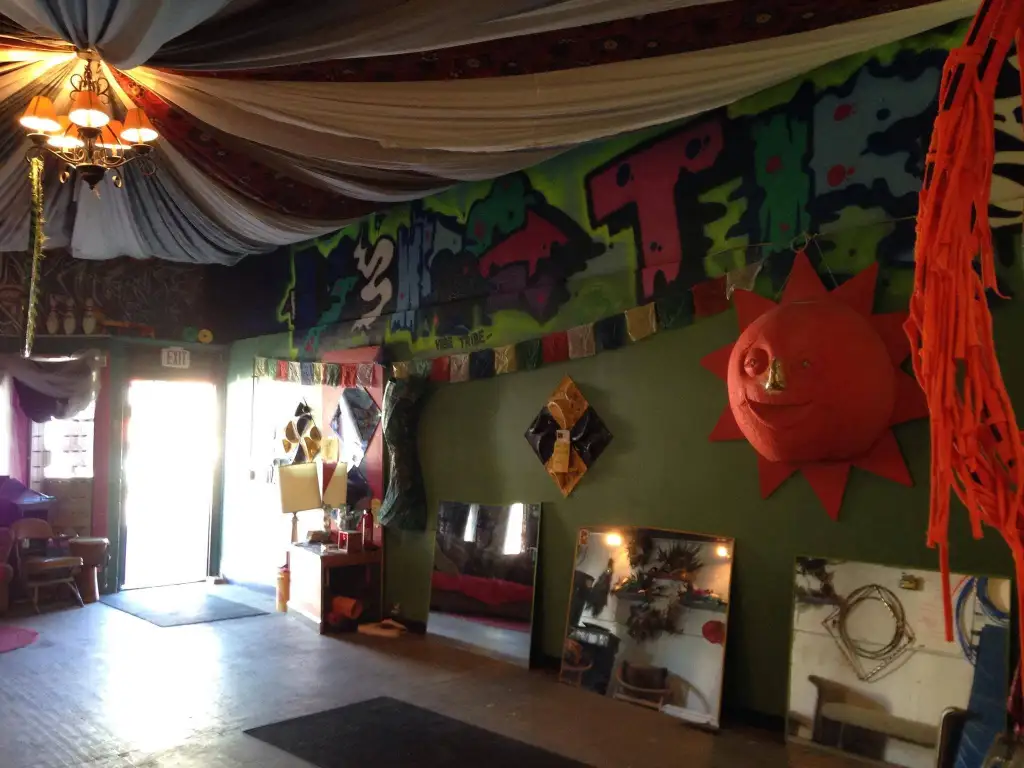
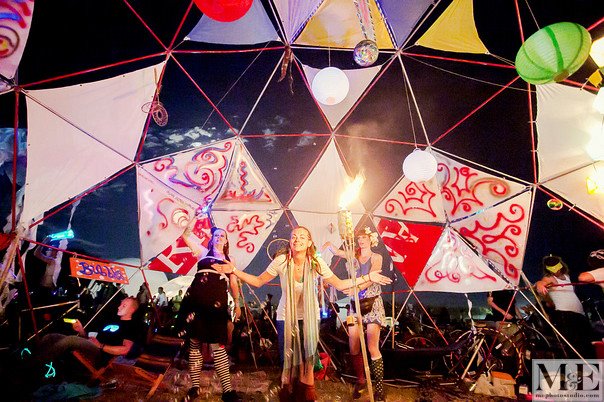
Well, Yosh’s Loft in the West Bottomes technically did it first and better, but around 2011, The VibeTribe KC emerged as something ambitious: not just a jam group—but a multidisciplinary artist collective full of: Fire spinners, Hoopers, Poets, DJs, Belly dancers, MCs, Painters, Performance artists, Costume designers.
MissConeption got a phone call asking “how many performance artists can you bring to Kansrockas?” which was a new arts festival at the Kansas Racetrack Speedway, with Eminem and GirlTalk headlining #swooon. She said “IDK, 60?” Then she promptly called 60 of her friends saying “hey, we got a gig! Let’s go!”
From that spun running the children’s activities at Harvest Festival at Mullberry Mountain in Arkansas, Wakarusa’s bluegrass cousin festival, performing at Wakarusa and running the fire circle for several years at that festival and other regional events. VibeTribe was even given an art studio for $1 a year for two years, thanks to the generosity of arts patron and real estate man Gregg Patereson, who also owned the Uptown Arts Bar. He dumped TONS of money into the performance arts, paying VibeTribers to busk and hold signs on stilts to draw attention to a flourishing arts district in Midtown. (We were definitely not making him any money.)
For a moment, at 5504 Troost, there was an actual attempt to build a permanent creative sanctuary, which offered free yoga, dance and flow workshops to the community. It was a ‘pay what you can’ dues system, where everyone involved was asked to contribute $25-50 a month to cover the overhead of water and electricity and keeping ice in the cooler on nights when we had events. (In two years we operated, not ne person ever actually paid any dues, and MissConception was stuck with the utilities and liability.) Haters mean you’re doing something right, right?
Parralelling this movement and supporting the ethos, Emerald City was a housing initiative attempting to infuse artists into houses on Troost, helping them get foreclosed houses and starting a Friday night art walk. All of it folded into the fabric of chaos when people started taking advance of the perks, breaking into the art studio, leaving he water running in the bathrooms all night to run up the water bill and sabbatogue the success of the organizers.
The VibeTribe was divided…. Half of the performers wanted to be professional, polished and paid well to ever leave the house. The other half wanted to give it away for free for the love on the street in jeans and sloppy t-shirts and looked like abunch of clowns who had nothing better to do but jam out with their clams out. Eventually, the organizer, MissConception, gave up and folded her cards, leaving town to escape the drama and criticism.
Spaces like the VibeTribe and Yosh’s Loft existed because people sacrificed for them. Landlords forgave rent because they wanted to see art in the city. Volunteers cleaned bathrooms for the love. People organized endless unpaid rehearsals for a shot at guest list opportunities because the promoters believed in the performing arts and knew we didn’t have any money, but we all wanted to support the music!
Nobody ever had any money, and when we did, when it was spit, there wasn’t much to go around per pearson. Guests lists and exposure, that was the most valuable currency. Oh, and we had a TON of fun. “One tribe, one vibe!” But small towns have loose lips.
KC Fringe Changed the Question
Then KC Fringe arrived and changed everything. Because suddenly, flow artists had to answer: “What are you actually saying?”
Not: “How many tosses can you do?”
Not: “How cool is your dragon staff?”
But: “What is the meaning of this performance?”
That’s when flow arts in Kansas City began evolving into:
- Theater
- Spoken word
- Immersive art
- Interdisciplinary storytelling
- Political expression
- Ritual
- Movement poetry
Groups like Vibe Tribe and Vesuvius helped push that transition publicly. Flow arts stopped being merely a spectacle. It became art.
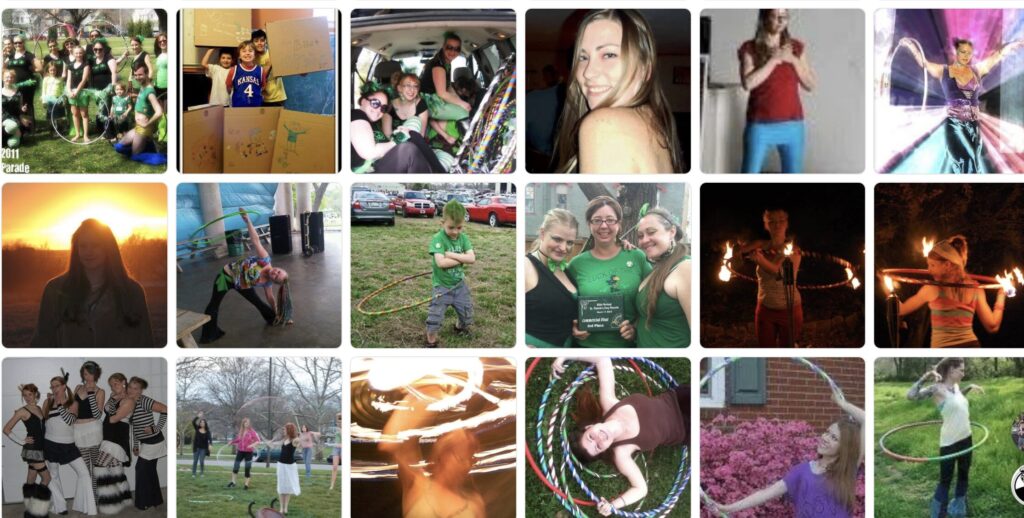
Don’t forget about the Hoop Mammas!
The Hoop Mamas are one of the most influential hoop dance and flow arts businesses to emerge from Lawrence, Kansas, and they played a significant role in the growth of modern hoop culture throughout the Midwest and beyond.
Founded in Lawrence in the late 2000s, Ali MacAuley head Hoop Mama started a handmade hula hoop company and quickly grew alongside the explosion of the flow arts movement that was happening at festivals such as Wakarusa, Burning Man, Electric Forest, and countless regional gatherings.
The company became known for producing high-quality custom dance hoops and helping introduce thousands of people to hoop dance as both an art form and a movement practice. By their own account, they have sold more than 40,000 professional hula hoops since 2008.